


A leading sector on the NSE
Six of the index banks gained between 49.81% and 93.17% in the year to 7 September 2026, per the NSE approval release.
WSA Banking Sector ETF
Kenya's twelve listed banks, in a single security.
The WSA Banking Sector ETF tracks the NSE Banking Sector Index. It is the first ETF created and domiciled in Kenya, approved by the Capital Markets Authority. It will list on the Nairobi Securities Exchange on a date the Exchange will confirm, and cannot be traded before then.
Approved
23 July 2026
Capital Markets Authority approval of the fund
Approved for listing
9 September 2026
Nairobi Securities Exchange conditional approval
Listing day
Coming soon
The Nairobi Securities Exchange will confirm the first day of trading
The Issuer
Founded in 2023 and headquartered at the Nairobi Securities Exchange, Wall Street Africa works at the intersection of capital markets intelligence, financial media and investment events.

A platform strengthening cross-border capital formation and global investor engagement with African markets.

From The Kenyan Wall Street to business intelligence, events and now Kenya's first locally domiciled ETF.

Co-founders Erick Asuma (CEO) and Andrew Barden (COO), with Ndegwa Mbuthia, Head of Capital Markets.

Quarterly research on Kenya's banking sector, free to read.
Downloads & Resources
How to Participate
Read the Information Memorandum and the fund's terms before making an investment decision. It will be published here before the fund lists.
Information MemorandumComing soonA Central Depository System (CDS) account holds NSE-listed securities electronically, and you need one to own units. Ziidi Trader (in the M-PESA app) and Hisa open or link the account for you when you sign up; a stockbroker or investment bank does the same when you open an account with them.
Once the fund is listed, place your order through:
The Investment Case
One security that holds Kenya's listed banking sector as a whole, in shillings, regulated in Kenya.
Six of the index banks gained between 49.81% and 93.17% in the year to 7 September 2026, per the NSE approval release.
Kenya's listed banks pay dividends to their shareholders, and the fund holds their shares. The Information Memorandum sets out how that income reaches unit holders.
Kenya's banking sector is consolidating. One unit carries exposure to every listed bank, whichever way that consolidation runs.
Proportional exposure to all twelve listed banks, in place of buying and managing twelve separate holdings.
Approved by the Capital Markets Authority and regulated in Kenya, with Tradiam Asset Managers Ltd as fund manager.
Past performance is not a reliable guide to future returns. The value of units can fall as well as rise, and dividends are not guaranteed.
Fund Partners
 Fund Manager
 Listing Exchange
 Market Maker
 Custodian
Get the Details
The WSA Banking Sector ETF is a passively managed fund built to track the Nairobi Securities Exchange Banking Sector Index. Rather than selecting individual bank shares, a single unit of the fund is designed to give proportional exposure to the listed banks that make up the index.
Wall Street Africa is the issuer. The fund is managed in partnership with Tradiam Asset Managers Ltd. Read the announcement of the NSE approval.
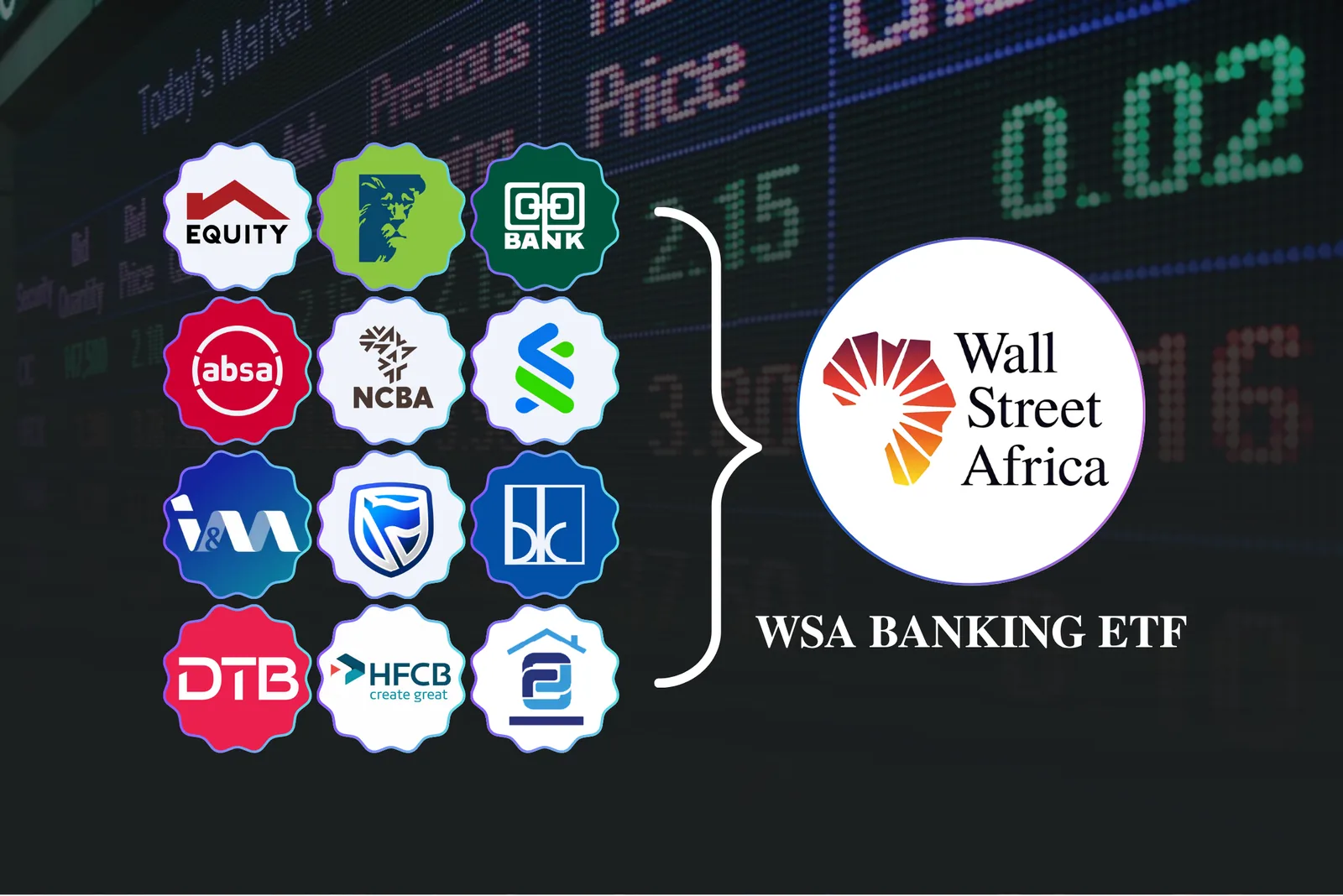
The NSE Banking Sector Index is made up of twelve listed banks, shown here by market capitalisation as at the close of 30 October 2026.
Existing ETF options available to Kenyan investors are domiciled outside the country. A locally domiciled fund is established and regulated in Kenya, under the Capital Markets Authority, and denominated in shillings. For a Kenyan investor that removes the currency conversion and offshore custody arrangements that offshore funds require.
| Bank | Market capitalisation |
|---|---|
| Equity Group Holdings | KSh 358.50 Bn |
| KCB Group | KSh 276.36 Bn |
| Co-operative Bank of Kenya | KSh 208.28 Bn |
| Absa Bank Kenya | KSh 163.14 Bn |
| NCBA Group | KSh 144.98 Bn |
| I&M Group | KSh 141.38 Bn |
| Standard Chartered Bank Kenya | KSh 115.15 Bn |
| Stanbic Holdings | KSh ~102.4 Bn |
| BK Group | KSh 55.80 Bn |
| Diamond Trust Bank Kenya | KSh 50.12 Bn |
| Family Bank | KSh 45.15 Bn |
| HF Group | KSh 22.81 Bn |
Frequently Asked Questions
Answers to common questions about the fund, how to buy it and the listing.
The WSA Banking Sector ETF is an investment fund that gives you exposure to a basket of 12 banks listed on the Nairobi Securities Exchange (NSE) through one investment.
Think of an ETF as a basket of shares. Instead of buying shares in several banks separately, you buy units in a fund that holds those shares. You can buy and sell the units on the NSE, and their value rises or falls with the underlying banking stocks.
The ETF invests in banking shares that make up the NSE Banking Sector Index, in line with its investment rules. The banks and their weightings can change over time; the latest holdings will be available in the fund's published information. See the index constituents.
Buying shares in one bank exposes you to that bank alone. The ETF spreads your investment across several listed banks in one transaction. It reduces reliance on any single bank, but you are still exposed to the banking sector as a whole.
Its price is mainly influenced by the prices of the banking shares held by the fund and by demand from buyers and sellers on the NSE. The trading price may sometimes be slightly above or below the value of its underlying investments.
NAV is the value of the ETF's assets minus its liabilities, divided by the number of ETF units. The price you see on the NSE may be slightly higher or lower than NAV because units trade between buyers and sellers.
Yes. The Capital Markets Authority (CMA) approved the ETF for listing, and Tradiam Asset Managers is its licensed fund manager. CMA approval does not guarantee returns or mean the investment is risk-free.
Tradiam Asset Managers manages the ETF, while an independent trustee, MTC Trustee, oversees the fund and a custodian, I&M Bank, safeguards its assets. The ETF's investments are held separately from WSA's ordinary business funds.
WSA stands for Wall Street Africa, the issuer and originator of the WSA Banking Sector ETF. WSA developed the product alongside the fund manager and other market partners.
WSA owns and operates The Kenyan Wall Street, a financial news and markets publication founded in 2015 by Erick Asuma. The publication covers financial markets, while the ETF is a separate investment product run with investment professionals.
You can buy it on the NSE once it is listed. The Nairobi Securities Exchange will confirm the listing date. After listing, you can place orders during normal NSE trading hours through a participating broker or supported platform like Ziidi Trader and Hisa App.
Once the ETF starts trading, you can buy units through a registered stockbroker or a supported trading platform, subject to the ETF being available on each. The channels are Ziidi Trader directly on M-PESA, a trading app such as Hisa, and your registered broker, including Faida Investment Bank and Kestrel Capital. See how to participate.
Yes. A Central Depository System (CDS) account is used to hold NSE-listed securities electronically. A registered broker or supported trading platform can help you open or link the account.
Contact a licensed stockbroker or a supported trading platform. They will guide you through account opening and identity checks, usually requiring identification and other personal or tax details.
The amount depends on the price per ETF unit, how many units you buy and the trading fees. For example, if a unit trades at KES 10, buying 100 units would cost KES 1,000 before fees. Check any minimum order requirements with your broker.
When you buy or sell, normal broker and market transaction charges may apply. The ETF also has ongoing operating expenses, measured by its Total Expense Ratio (TER), which are reflected in the fund's value rather than charged to you as a separate bill.
Yes, indirectly. Banks pay dividends to the ETF rather than to each ETF investor. Eligible income is then distributed to unit holders under the fund's approved dividend policy, after applicable taxes. The amount is not guaranteed.
You may make a profit if the price of your ETF units rises and you sell them for more than you paid. You will also receive dividends when the ETF declares distributions. Neither source of return is guaranteed.
Yes. If banking share prices fall, the ETF's value can also decline. You may receive less than you invested when you sell. Owning several banks helps reduce single-company risk but does not eliminate investment risk.
Yes. After listing, you can place a sell order through your broker or trading app during NSE trading hours. The sale depends on finding a buyer at an acceptable price, so it may not happen immediately.
This page is for information only. It is not investment advice, and it is not an offer or a solicitation to buy or sell any security. Read the Information Memorandum and seek independent professional advice before investing. See our Terms of Use.
This page is for information only. It is not investment advice, and it is not an offer or a solicitation to buy or sell any security. The WSA Banking Sector ETF is approved but not yet listed, and nothing here should be read as an invitation to invest. See our Terms of Use.
Our team can help with questions about the fund, how to buy and the listing.